
June 16, 2026
Articles
How to get poor-fit candidates to self-screen out
An instinct that's costing you
Your team is drowning in applications, your assessment spend is climbing, and seeing the quality in the candidates who do make it through is time-consuming work.
The instinctive response is to close early, add in more filtering or other reductive stages; and these approaches all share the same assumption: that the employer should decide who progresses and who doesn't. What if the real fix is helping candidates make better decisions before they apply?
Some candidates have spent hours researching your role, your culture, and what the job actually involves. Others clicked 'quick apply' whilst watching The Great British Bake-off and scrolling on their phones. They all land in the same pile, both cost you the same resource to process and these days, some candidates can even look identical until you've spent money assessing them.
The key difference between these candidates isn't ability. It's intent. Demonstrated through genuine engagement, reflection, and informed self-selection. Intent is a far better predictor of who will convert, who will stay, and who will perform. The act of submitting an application is no longer a sign of commitment or quality, and the place to surface a candidate's intent is before the application, not after.
Why adding more screening questions doesn't filter low intent candidates
The key to genuine reflection is that it needs to be honest, and to be truly honest humans need to feel like they are not being judged by what they say or do. Just as in life, psychological safety is paramount to getting people to take an honest view of an opportunity, empowering candidates to make an informed decision that benefits them and you as the potential employer.
So let's say you take this concept of creating reflective questions around the role and you place them in your application form. These questions, whether you intended to use them as such or not are now officially a part of your selection criteria. You have access to the responses and candidates immediately go into impression management mode, treating them as though they will be reviewed and assessed, just like a classic motivation statement.
Any mechanism you use to differentiate between candidates functions as a selection tool, with all the fairness and compliance implications that follow. The ICO's guidance on automated decision-making in recruitment has made this increasingly clear. Most importantly, screening questions do nothing to change the candidate's own understanding of the role. They ask the candidate to perform for you, questions will be answered how the candidate thinks you want them to be answered. This does nothing to help the candidate evaluate whether the role is right for them.
The information gap that drives poor-fit applications stays wide open.

A content framework that drives self-screening behaviour
The Decision Factor Framework (part of IntentSignals) addresses all of these problems by shifting the decision from employer to candidate, and grounding that shift in established behavioural science.
Separate from the application experience
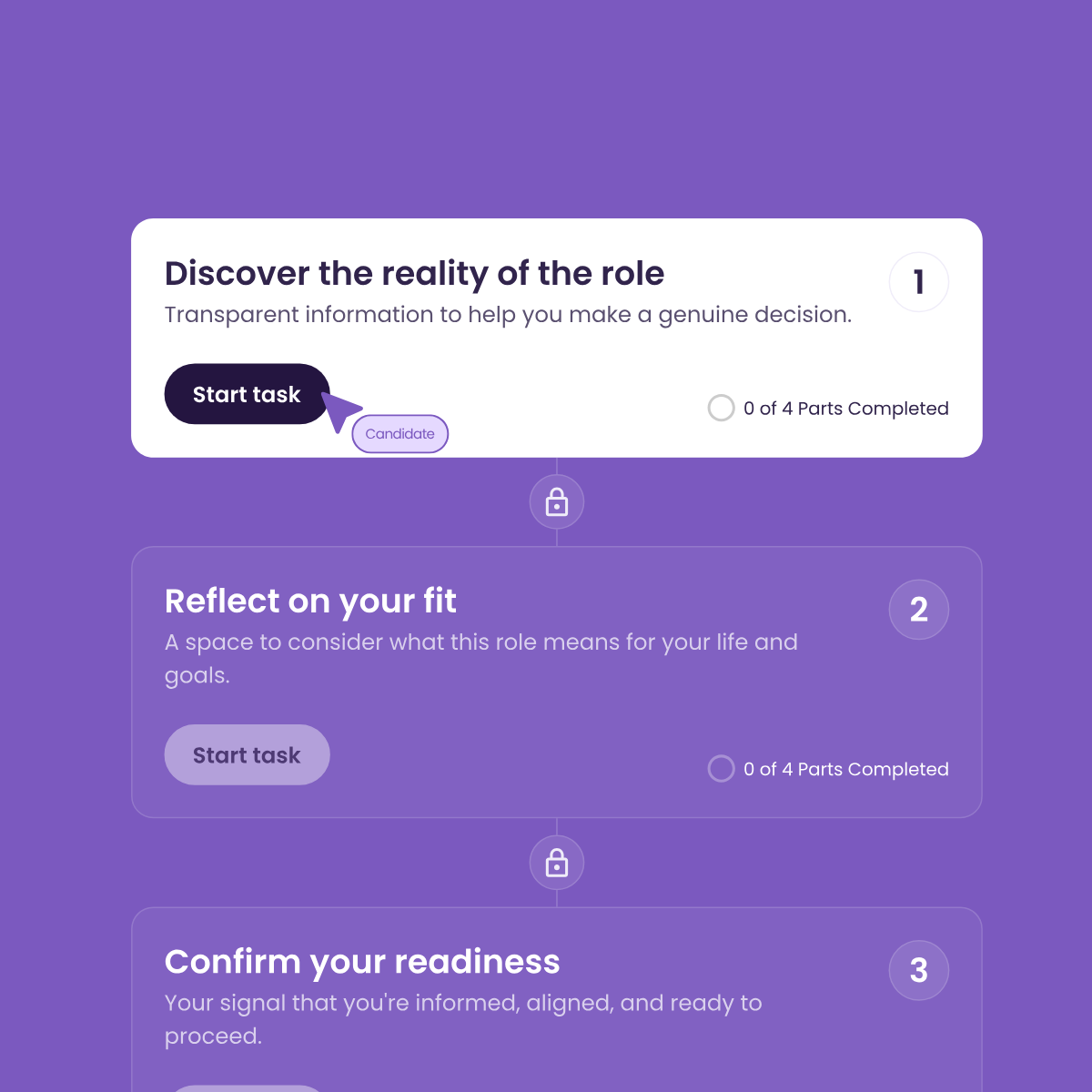
A candidate is told very clearly and upfront that this journey is for their self-awareness only. The experience lives in a separate home to the application form and assessments, making it visually and functionally distinct. A certain and confident candidate may go through this journey in 10 minutes, others may reflect more deeply, but typically between 30-60% come to realise something that doesn't meet their needs or goals and choose to leave the process. All candidates regardless of their outcome leave more self-aware and clearer on what they want.
Any intervention between a candidate and an application form must be scrutinised for fairness. The framework addresses this through three embedded design principles, and every journey is consulted on by our expert content team.
- Content is framed in terms of what success looks like in the role, not as requirements that might inadvertently discourage candidates from underrepresented backgrounds. Hard eligibility criteria are separated clearly from softer preferences. Language is growth-oriented and invitational throughout.
- Where employee voices and stories feature, they deliberately reflect diverse backgrounds and non-linear career paths. The tone normalises choosing not to apply for the right reasons, challenges are presented as honest context, not warnings designed to intimidate.
- Every question is design to trigger reflection, to prompt the candidate to ask themselves and answer for themselves.
Discovery
The experience gives candidates an honest, balanced picture of the role; the realities, the demands, the less glamorous parts that goes well beyond your job advert. Candidates with the lowest intent, and those who spot clear mismatches, leave at this point. They leave because the information empowers them to. Realistic job preview research has shown since the 1970s (Wanous, 1973) that balanced, honest information enables better self-selection and reduces post-hire turnover. What's new here is operationalising it as a structured pre-application step rather than spreading information out across channels and hoping that candidates will find it and consume it before applying.
Reflection
This is where the framework diverges most sharply from anything an ATS can do. Candidates encounter what the framework calls "decision factors" - structured moments where they're prompted to actively consider whether the role aligns with their values, lifestyle, and goals. There's no score, no right answer, and no employer-side evaluation. This is a tool for candidate to assess themselves and the role. Drawing on Self-Determination Theory (Deci & Ryan, 1985), which shows that autonomy-supportive processes produce more stable, committed decisions candidates are reflecting on what it means for them, personally. This reflection is the mechanism that drives the self-screening behaviour.
Commitment
Here, candidates can consolidate their learning into an active, affirmative decision to proceed. The act of making an explicit commitment significantly increases follow-through and candidates who reach this point are making conscious choice, returning the act of applying to a much stronger signal of intent and alignment.
30-60% reduction in applications, 2-4x better conversion
This framework has been deployed across early careers hiring in aviation, engineering, retail, and professional services already so far. Application volumes reduce by 30–60% compared to equivalent roles without the intervention. Candidate quality downstream improves, with record-breaking interview scores and even improved turn-out rates.
Candidate experience is overwhelmingly positive. Satisfaction ratings consistently exceed 4.7 out of 5 for well over 50,000 responses to date. Candidates describe the experience as fair, motivating, and refreshing.
And this is achieved with no integration, no technical setup, and no dependency on your ATS. The experience sits between your job advert and your application form.
The Decision Factor Framework is developed and deployed by Connectr Talent Technology as part of IntentSignals.

Early Careers
Turn your outreach into outcomes.
Keep talent engaged long after first contact. Effortlessly build an active early careers pipeline through a personalised candidate experience that delivers real-time insights.

Employer Brand
Activate your employer brand.
Tackle misconceptions and nurture awareness through authentic experiences, with a platform that tells you what’s working and what isn’t.

Talent Acquisition
Transform your recruitment strategy into a reality.
Build a best-in-class candidate experience that uncovers top talent and reduces time-to-hire without compromising on quality.

.jpeg)
Ready for more engaged candidates and better prepared hires?

